

is boycotting really a privilege?
:the paradox of individual responsibility

In Michael Shur’s “The Good Place,” a universal point system dictated who would enter “the Good Place,” a metaphorical heaven, or “the Bad Place,” a metaphorical hell, after they die. Every action a person does is recorded as “goodness” points if they are of positive intent and outcome, or those points are deducted if they are of negative or self-serving intent. In order to enter the Good Place, one must accumulate at least one million points. As human society grew more complex in contemporaneity, there existed more ethical hoops for each individual to jump through in order to earn points. Globalization caused the point system to become less straightforward, and something like buying an apple is a net negative: via exploitative labor, the polluting fuel used to drive to the store, the plastic that holds the bag, and perhaps the farm it came from was owned by a man who is a descendant of slave owners. Inevitably, even by trying to make decisions perceived as good, in this universe, every minute detail is recorded along the chain of contact and calculated into a net negative.
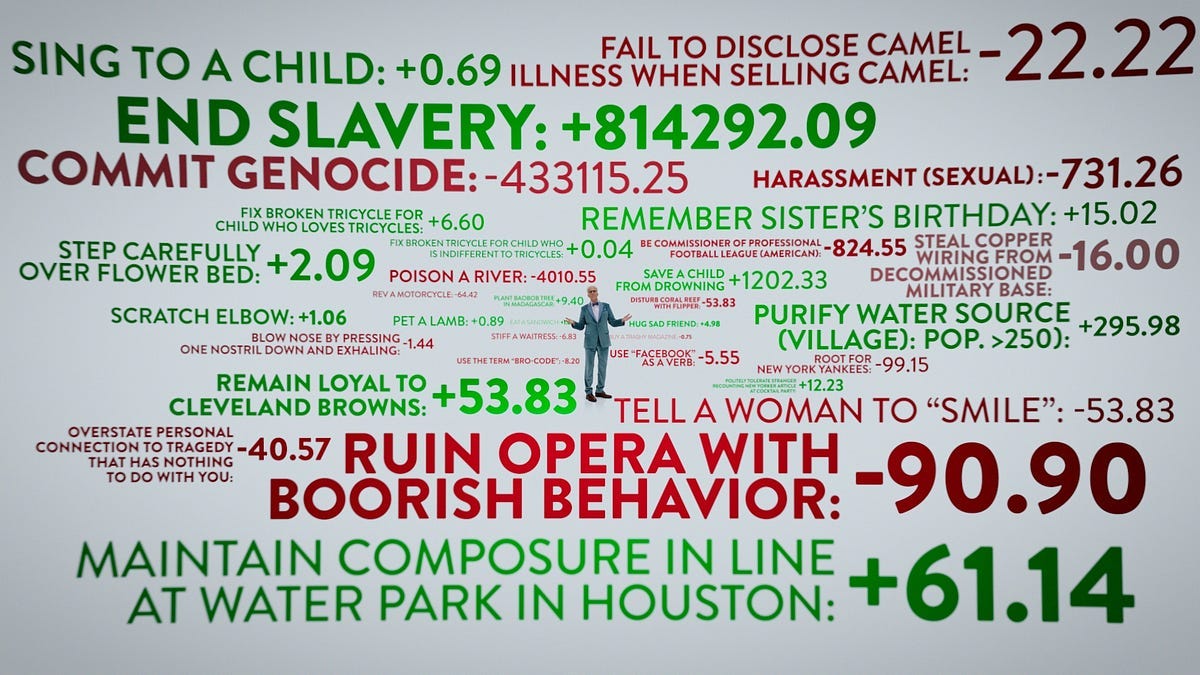
The Good Place’s point system acts as a metacommentary on the challenges of making ethical and good choices in our current world. Decisions are never black and white and are not solely our own, but also can impact those around us. It is also true that globalization has widened the scope of who we impact. Thus, an act of something like purchasing a new piece of clothing can increase the sales and output of a company that exploits young children across the world, but within commodities, this reality is intentionally obscured. How are we to know that such thin threads were woven by adolescent fingers?
Truthfully, we are not meant to know. And despite how battered Karl Marx’s corpse is from the amount of times I’ve dragged him out for the purpose of explaining commodity fetishism, this principle has found itself inundating us.
Commodity fetishism occurs when commodities no longer derive value from their labor, utility, and production, rather a “mystical” value is ascribed to them through cultural and social narratives. Exclusive to capitalism, we ask not what these commodities can do and the process by which they were made, but simply what they mean to us. When you go to the store to buy bread, you see a plastic encased loaf and the money that you possess. You don’t know, and likely don’t care, if the person who harvested the grain for the loaf was well-compensated for their work or even the kind of labor that was offered up for it. Maybe their firm blocked unionizing attempts.You wouldn’t know.
Continuing, a working essay of mine on the moral pitfalls of participating in fashion mentions this perspective:
But the imperialist core is intentional in obscuring this reality. The items we possess are believed to have fashioned out of thin air, and our commodities are fetishized as mystical realities. The newest and brightest is only known by its shine, not the dull days worked to present it before you. I think it is within this that the fashion industry’s destruction finds itself fetishized the most.
Fetishism is a cornerstone of capitalism, which fails to exist without the contradictory exploitation of capitalism. The same way your employer wants to give you as little as they can get away with, you want to make as much as you can get away with; you want to purchase commodities with your income, and the commodities are made through exploitation and concealing the arc of their production. In this manner, in attempting to advocate for anti-capitalism and the conclusion of its inherent exploitation, what can be done?
The world has experienced its fair share of social and societal movements that have altered the nature of their environments. Broad uprisings have changed economic and government systems. But in this stagnant and substantial imperial core, referring to the United States, we have yet to see anything as dramatic as the American Revolution, that of itself is argued to have still been conservative.1
In this sphere, individualism has grown; from cars, to suburbs, to highways, to designers, to equity, privacy in our property has grown to be our most significant virtue. Much of our products are generated overseas before being repackaged for our domestic consumption. Globalism has broadened the scope of those we coerce to generate our commodities, and we are not meant to know that the cobalt in our phones is mined by slaves in the Democratic Republic of Congo. Yet, we are beginning to know as news and social media spreads this info and relays to us what evils are connected to our possessions. Such as with Israel’s genocide on Palestine, BDS had brought awareness to what businesses should be boycotted for supporting the vile acts. But even as we learn and know these things, these businesses still revel in profits and existence. McDonald’s still expands business and makes sales. Starbucks is still well-known and loved. One could attribute this to a silent majority who is unaware of the social consensus of boycotting, and I agree to an extent, but I want to focus on those who are aware of the social scope.
I once attended an event where everyone displayed their outfits and proudly described the pieces they purchased from Shein. It is well known that Shein participates strongly in the fast fashion world of cheaply, unsustainably made clothes where children and women undergo terrible conditions and low wages to produce. Despite this, a $6 t-shirt does not show this, and the polyester hides this reality. People do not see the faces of those who suffered to produce their garments, thus they believe it to be out of their hands.
Shein is an obvious example, and many are able to reach the conclusions that other clothing shops with similar pricing may engage in the same practices as Shein, but it is not as simple. Even a subsidiary of Louis Vuitton, Dior, has been probed for sub-contracting work from firms that mistreat their workers, and “a Dior handbag that sells for $2,700 costs only $56 to make.”
We are so far removed from even knowing these things, and capitalism intentionally sanctions these behaviors. Thus, many of those have attempted to remediate the guilt others feel over participating in unethical purchasing and spending with a new slogan that goes, “There is no ethical consumption under capitalism.”
I have come to loathe this saying deeply. A term that seems to expunge all culpability from all participants. Individual acts mean nothing, rather, we are supposed to focus on collective action. Except, no one does anything collectively! No one can collectively boycott, collectively share, or collectively oppose anything. We are in a circle rubbing each others’ shoulders, telling one another not to feel bad for anything we do at all. Since when was it human to shrug at suffering?
Many don’t really know just how privileged the imperial core is. The things that you have access to are mountainous compared to the imperialized. You fill your closet with polyester that will disintegrate, be disposed of by you, and end up polluting Ghanaians with plastic. And you put your hands up and swear you can do nothing. People lack the discernment for this dilemma, and they may point out something along the lines of, “So, does that mean I cannot have a phone anymore since they have cobalt made by slaves?” That would be much preferred, except unfeasible in our contemporary world. To that I ask, must you have the latest and greatest? Is it too much to prefer a used older model that is not continuing to contribute to cycles of exploitation? Case by case, they say.
I think the most controversial topic of abstaining from certain purchases is the food industry. Food production and consumption contributes to approximately a quarter of all emissions. Some of the greatest contributors are the meat and dairy industry, yet the US consumes some of the highest rates of this. Factory and industrial farms are often where these items derive from. Despite this, many dare to say that meat is a product they can simply not live without. For cultural and social reasons, meat is often considered the main component of nutrition. Studies have shown that, “people eating meats along with other foodstuffs (omnivores) had more than twice the carbon footprint of vegetarians and vegans.” Thus, the obvious choice would be to make proactive reductions in meat and animal-product consumption, as these diets are also, on average, more affordable in high-income countries. Many in America believe animal products are cheaper, but they are illusioned by government subsidies that intentionally hide the true cost of the industry. Not to mention, the vile conditions of animal slaughters, not just for the animals, but the workers as well. Abstaining saves money, reduces emissions, and decreases biodiversity loss, and “if everyone shifted to a plant-based diet, we would reduce global land use for agriculture by 75%.” Yet even progressives swear they simply cannot do it. Not for any feasible reasons, but just a personal preference of inability.
By no means is the agriculture industry sans the animal production aspects perfectly ethical and sustainable. Avocados, for example, contribute to a lot of deforestation, water use, and excessive greenhouse gas emissions from transporting the fruit across borders. Not to mention, the exploitation of migrant workers. In this case, discretion is necessary, and one may recognize this as a case of capitalism rearing its ugly head in the net positive of plant focused diets. But it is not just plant-based diets who consume this. It is also the omnivores as well. But it would simply be too ridiculous to ask people to reduce their consumptions of avocados? Interesting.
Similarly, Artificial Intelligence has received increased visibility regarding its effects on the environment. The computational demands of generative AI require excessive electricity that generates carbon dioxide in mass quantities, and the data centers utilize a great deal of water to cool the systems. A year of human life in America produces about 36,200 lbs of carbon dioxide on average, while training an AI model uses 6,262,000 pounds. Furthermore, within primarily Black communities in Memphis, an AI supercomputer touted by Elon Musk pollutes residents and exacerbates health problems. This destructive technology is actively killing people, and it is right to actively blame Elon Musk and other corporate shills for their direct participation in it, but we ourselves must also resist participating. AI has exploded and wormed its way into all of our societal crevices: AI therapists, AI grocery lists, AI dieticians, AI grammar checkers. We find ourselves involved because of how easily corporations have made it for us to access. But we must boycott this cycle of death and poisoning continually offered to the populace. Simply because we are not witness to its effects, we write it off, but it is important to remain cognizant, to remain aware.
Many may argue, “What about poor people? What about accessibility?” To that I wonder why, within the imperial core, do we always think our struggles are the worst? If the actions we take for “survival” yield negative results for those below us, we automatically make the assumption our livelihoods are worth more than the societies we exploit. That mindset is racist and fascist. Individuals make up a collective, and collectives make movements, so these operations must begin somewhere. If you and your neighbors all were to drop a teaspoon of water into a cup everyday, would it not at some point overflow?
The one thing that errs us is feasibility. It is not very feasible to choose to drive an electric car for the environment, because of the degree of inaccessibility made with intention by the disastrous and destructive oil and gas industries. To abstain from driving in somewhere like the Houston suburbs would be close to impossible, especially when trying to travel to work to make ends meet. To choose public transit or walking does not come without thorns, and things like location and infrastructure can make these options more or less viable.
But this is why I inquire not for perfection but for effort. Choose plastic over paper, vegetables over meat, reuse over buying new. Yes, perhaps we can truly point fingers at corporations who tug the strings we have no control over, but I think it is wasteful and useless to not attempt to take any responsibility for individual choices. Especially when we know exactly the damage we are procuring. For if you take down these corporations, will you even be prepared to make the transitions necessary to sustain a harmonious society? If suddenly all food was free to the world, would you even know how to make the ethical choices? Furthermore, how do you think movements that brought us this life did it? Did they not boycott buses and stores and restaurants to give us equal rights? Is it just too damn hard for you?
Redundancy of moral points and comparing cards does not get us very far, but we must work towards our better world. Many of the things mentioned in this article may not be things you are familiar with, and now you are. Knowledge is a curse that we come to bear, and when we learn that our steps crush the spines of others, we should cease walking in that direction. I consider this a training course for the future: a vision in which we do have choices and options and we can bear the weight of them wholly. It is an optimistic perspective. Consider, possibly, the ways you can prepare for your responsible future.
Additionally, boycotting is not just removing things from your life. When you stop going to Starbucks all the time, maybe you have now discovered a new Palestinian restaurant. Maybe you boycott Spotify for physical CDs, and you discovered a secret track in one of your favorite artist’s albums. Or maybe you decided to carpool and made a new friend. Perhaps took the bus and discovered new parks you want to try that you never noticed while on the highway. Maybe tofu is actually really good. Maybe there are better clothes at a thrift store than Target. One day at a time, I ask you to consider ways you can adopt these training wheels into your life.
The American Revolution removed the hands of the monarchy, but everything else mostly stayed the same. See Edmund Burke
Hey, great read as always. This makes me think about ethical AI and how complex it is to ensure positive outcmes with every choice.